

College tuition getting more expensive for those who can afford it the least
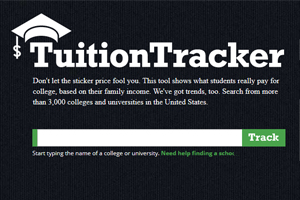
Click to try out the Tuition Tracker.
As universities and colleges increase their tuition, a larger share of it is falling on the lowest-income students and their families.
Those are among the findings of an investigation by The Hechinger Report, the Dallas Morning News, and the Education Writers Association, which used federal data to show that lower-income and working-class students at private colleges and universities have seen the amount they pay, after grants and scholarships, increase faster than the amount their middle- and upper-income classmates pay.
Then again, as costs rise, even people in higher income brackets may have trouble paying. It’s a complicated topic that was the subject of this segment on the National Public Radio program Here & Now, with The Hechinger Report’s higher-education editor, Jon Marcus.
Read the original package of stories here.
Interview: Sarah Butrymowicz on Common Core roll out
Hechinger Report staff writer Sarah Butrymowicz took part in a podcast with Bloomberg Radio this week about the Common Core State Standards. She joined Erin Richards of the Milwaukee Journal Sentinel and Andrew Ujifusa of EdWeek to discuss:
1. Are the controversial new standards in trouble?
2. How is their roll out affecting classrooms around the country?
3. How well are reporters covering them?
Listen to the podcast here.
How to boost college graduation rates for black and Latino males
While black and Latino men attending community college have some of the highest educational goals of any racial or gender group, they are also the least likely to achieve them.
That’s one of several findings included in a new report from the Center for Community College Student Engagement, which suggests that black and Latino men graduate from college at disproportionately low rates partly because they arrive less prepared and can suffer from discrimination and stereotyping, or a fear that they will live up to negative stereotypes.
The release of the report comes a day before President Obama is expected to provide details on a new initiative to improve the lives of young men of color. Obama has said the initiative, called “My Brother’s Keeper,” will be led by a mixture of foundations, public officials, churches, and non-profits.
Related stories
Black and Latino males are more likely to attend community colleges than four-year universities, the new report found. And, on average, they are more ambitious and engaged while there — seeking out academic help, and not skipping class, for instance — than white male students. And 87 percent said they hoped to earn an associate’s degree, compared to 80 percent of white men.
Yet only five percent of Latino and black men earn certificates or degrees within three years, compared to 32 percent of white men.
Black and Latino men report using just about every form of academic support provided by their community colleges — tutoring, computer labs, study skills courses — at higher rates than white men with the same GPAs. That finding suggests that black and Latino males have to work far harder to achieve at the same levels as their white peers at community colleges.
“Race and ethnicity intersect in complicated ways with gender, socioeconomic status, college readiness and other factors,” the report’s authors conclude “There remains the necessary and unequivocal recognition that in this society, race matters.”
Many of the suggestions for improvements fall into the categories of helping black and Latino male students build strong relationships with mentors, improving the diversity and cultural sensitivity of faculty members, or strengthening the remedial courses many struggling students take when they arrive at community colleges.
Among the model programs described in the report:
- Jackson College in Michigan created an intensive mentoring program for minority male students called Men of Merit, which includes biweekly meetings with mentors who can provide academic and career advice. Black men who participated in the program in the fall of 2011 had an 81 percent chance of making it to their second semester, compared to 61 percent of black male students who did not participate.
- Most of North Carolina’s community college take part in what’s known as the Minority Male Mentoring Program, which works with both full- and part-time students to provide academic advising, study skills courses, and chances to take part in community service. That program, started in 2003, has significantly boosted retention rates for minority men.
Skip school and lose welfare? The good and bad of Australia’s tough tactics on truancy
What if the punishment for skipping school was a loss in welfare benefits for your family? It’s a strategy that some politicians are considering in the U.S. – plans have been floated in Missouri and put into action in Michigan last year.

Australian students in their final year of high school take a break during a conference about what to do after graduation. The country is trying to boost its high school completion rates to 90 percent. (Photo: Sarah Butrymowicz)
But in Australia, they’ve already tried it, and the experience is a cautionary tale.
In 2008, Australia’s high school graduation rate was about 75 percent, according to the Australian Bureau of Statistics. That’s about the same as in the U.S., where it’s nearly 75 percent, but it wasn’t good enough for Australian officials. Many states there allowed students to leave at the age of 15, following their 10th year of schooling and just before college preparation work begins. Thousands dropped out. So that year, the Australian government set a target of 90 percent high school completion. Within a few years nearly all states had increased the age to 17.
Still, the Australians thought they should do more. To make sure all students stayed enrolled until they were 17, officials put strict penalties in place and a series of supports for truants, such as opportunities to work with social workers. Parents could also be fined up to $11,000. And, as a last resort, parents on welfare could lose their payments if their child was truant.
The logic was simple: if parents needed the money, they’d make sure their child got to school.
Attendance did improve in areas where the program was piloted, by about 5 percent. But a 2010 evaluation by the Australian Department of Education found that it decreased after an initial bump and low-income students still had lower attendance than their peers. Critics said that the increases weren’t enough to justify the cost of the program – about $3 million a year for the trial in 44 schools.
Related stories
At the same time, only a relatively small number of parents lost their welfare payments. In the first two years just 95 out of about 6,600 parents in the trial program were affected and all of them had their payments reinstated, according to the Sydney Morning Herald. In 2012, Queensland stopped cutting welfare payments to parents of truants because attendance didn’t improve.
The program got mixed reviews from parents. Many of them “perceived the program as a ‘big-stick’ approach to dealing with attendance issues,” according to the government evaluation. But they also saw some positives. Even if the strategy didn’t lead to significant increases in attendance, nearly half of parents said that “the implementation had made them think about the importance of their child’s schooling,” the evaluation said. “A further 29 percent also noted the program had encouraged them to make more effort to address their child’s attendance issues.”
Will Louisiana’s students be ready for online testing?
NEW ORLEANS — Starting next school year, thousands of Louisiana schoolchildren will begin taking standardized tests online as the state moves to a new test aligned with the Common Core curriculum standards. But a new report released by the Louisiana Department of Education suggests that about one-third of the state’s districts still have to purchase more computers or upgrade their technology infrastructure in order to be ready in time.
The state recommends schools have a ratio of seven students to every one computer (including desktops, laptops, and tablets) and meet specified bandwidth requirements. A few school districts, such as St. James Parish, have a 1:1 ratio, while several others remain far from the 7:1 target. (The report does not include information from the dozens of state-run charter schools in New Orleans because that information is still being compiled, according to a department spokesman.)
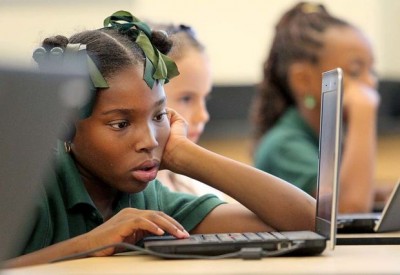
Third grader Keimonni Conner does MAP testing to determine reading and language skills at Lawrence D. Crocker College Prep in New Orleans Friday, Aug. 16, 2013.(Photo by Dinah Rogers, NOLA.com / The Times-Picayune)
Next spring, Louisiana students will start taking an online test known as PARCC, which is being developed by a consortium of states that are all transitioning to the Common Core. Students in grades five through eight will take the new test online in the spring of 2015, while younger children in grades three and four will continue with paper and pencil tests for an extra year.
The shift to online testing poses major equity concerns, and not just because some districts have stronger bandwidth and more computers. Middle-income and wealthy students are more likely to have regular access to an array of tablets and computers at home that will help them become more proficient with typing and other keyboarding skills. Partly for this reason, several schools in the New Orleans area are adding keyboarding classes or requiring students to take online tests over the course of the school year to practice.
As part of an ongoing conversation on New Orleans education issues, Hechinger’s Sarah Carr spoke with WWNO’s Eve Troeh recently about technology readiness and the ways online testing could exacerbate the digital divide.
You can listen to the interview:
Can the U.S. learn from Australia’s high bar for new teachers?
A major ongoing fight in the U.S. is how to make the teaching profession less a clock-in, clock-out job and more like the high-paid, high-demand career of a lawyer or doctor. Unions and teachers argue better pay will elevate the profession. Politicians and advocates want to put more scrutiny on teachers and end tenure, arguing that no other profession offers protection for life.
Australians have moved beyond these bitter debates to take action, and the country’s treatment of teachers shows what compromises between the two sides might look like here.
In Australia, professionalizing teaching has been at the heart of a number of reforms. Teachers can rise to many different levels without having to leave the classroom for administrative jobs, an idea that’s gaining traction in the U.S. Mentor and head teachers who take on more responsibilities are common in Australian schools, for instance. They work with younger teachers and get paid more to do so.
Most recently, Australians have also made it tougher to become a teacher in the first place. Teachers no longer earn their accreditation – or certification as we call it – once they complete a teacher preparation program. Instead, they must provide documentation from their first year of teaching to prove that they meet national teaching standards in knowledge, practice and commitment and that they have met or are working to meet self-set professional goals. They must go through this procedure every five years to maintain their accreditation. If they fail to do so, or have not met the standards, any school that continues to employ them will be fined.
It’s worth noting that American advocates are also pushing to better evaluate how new teachers perform in the classroom before awarding their certification. Twenty-eight states have either adopted or are considering adopting the Teacher Performance Assessment, which requires students in teaching programs to supply a 10- to 15-minute video of themselves teaching along with lesson plans, reflection essays and proof of student learning, as a certification requirement for teaching candidates. Randi Weingarten, president of the American Federation of Teachers, has argued for a tougher exam for would-be-teachers as well, using the bar exam for lawyers as an example.
The bar in Australia is higher, though. All new teachers must prove themselves throughout their entire first year of teaching before they’re formally accepted into the profession. Some Australia states, including New South Wales, where Sydney is located, have had this requirement for new teachers for a decade now. Some older teachers in a Sydney suburb, who have worked as mentor teachers with newcomers, told me they see it as a largely positive law. Not only does it force teachers to work hard to improve, they say, it’s also helped to make teaching feel more legitimately like profession such as engineering or law.
What do Americans want for their schools? Choice, yes. Charters, not so much
What’s a charter school? Or the Common Core? A new poll out today suggests many Americans are unfamiliar with the hottest topics in the education world, and that they’d rather trust their local schools and teachers—not the federal government, their elected officials, or unions—to figure out what’s best for kids.
 Surveys have long found that Americans strongly believe in decentralization and think the schools near their home are doing fine, while schools elsewhere in the country need help. What’s surprising in a new survey published today by 50CAN, a reform-oriented advocacy group that supports more rigorous teacher evaluations and early education, is the relatively lukewarm response to some of the most favored ideas for improving the school system among education advocates and many elected officials.
For example: In theory, it seems like Americans would embrace charter schools, according to the poll, which surveyed 6,400 Americans. Seventy-three percent strongly supported “giving schools the ability to make changes without having to cut through administrative and bureaucratic red tape,” one of the main reasons charters were created in the first place.
But 44 percent of those surveyed thought charters are private schools, which they aren’t. And compared to other ideas, like giving principals more freedom, which 77 percent strongly supported, opening more charters or “using public school funding to create schools that are allowed to set their own administrative rules and explore innovative solutions,” the basic definition of a charter, had fewer enthusiastic backers (only 54 and 58 percent strongly supported those ideas).
The poll also suggested that Americans still aren’t sold on the Common Core State Standards, a set of internationally benchmarked standards in math and English adopted by 45 states. While two thirds of those surveyed said they supported “holding all students across the country to a uniform set of high standards,” less than a third supported the Common Core.
Related Stories:
“Most Americans would support the Common Core if they just knew what it was,” the report authors wrote.
Another popular idea that many education advocates embrace was also farther down the list: Providing all 3 and 4 year olds with preschool (62 percent strongly favored this strategy). Two thirds isn’t a bad showing, of course, but the ideas with overwhelming support were focused on giving more power to the teachers and principals inside actual classrooms, with one caveat: That they be better trained.
The most popular strategy among those the survey presented to participants called for reforming not K-12 schools, but the schools that teachers themselves attend. Seventy-nine percent strongly believe we should set “a much higher standard on teacher training programs and entrance tests to ensure a quality teacher in every classroom.”
Lessons from abroad: If Republicans controlled U.S. education policy? Australia offers a sneak peek
What would happen if conservative ideas for improving education were given free reign in the United States? If Republicans take over the Senate and then the White House, a possibility, Americans might find out in the near future.
Australia, similar in many ways to the U.S., provides a glimpse of what a transfer of power might mean for schools.

Photo: Marco Antonio Torres
In 2013, Australia’s conservative party won control of Parliament, ousting a progressive Labor Party majority. The significant left-to-right swing has left many parts of the nation in flux, including the education sector. Like the U.S., Australia has significant urban and rural student populations and struggles with balancing state and federal authority.
Both countries have a significant portion of children living in poverty – roughly 17 percent in Australia and about 22 percent in America. And Australians, too, are concerned with how they rank on international assessments.
Their main strategies for fixing schools, such as providing more choice to students and addressing standards, are also similar to ours. As the new conservative government launches its education policy, it could offer clues to how their strategies might play out here.
I spent the past week in Australia and nearly every educator that I talked to mentioned how many uncertainties the country’s schools are facing right now – and were generally pessimistic about the new government. The current unknowns also show just how difficult it can be to install lasting changes in an education system when the balance of power keeps shifting. Here’s some of what’s at stake:
• School funding. In both K-12 schools and at universities, educators are anxiously awaiting a final budget from the new government. The previous government pledged more than $944 million between 2013 and 2017 to the Higher Education Participation and Partnerships Program. All of the country’s universities were charged with designing programs to attract and support disadvantaged students in exchange for the funding. Now, no one knows if they’ll have the federal money to continue these programs. If not, institutions may have to scale back or scrap them all together.
At the primary and secondary level, the government originally planned to create its own funding formula, but committed to the liberal Labor Party’s previous funding levels for at least the next four years in response to pressure.
• School choice. Australia’s new education minister, Chris Pyne, is a vocal proponent of school choice – or giving students multiple options of where to attend. He’s announced plans to give $70 million to Australia’s Independent Public Schools Initiative, which, not unlike the charter school movement in the United States, aims to create schools that operate outside of the bureaucracy of the traditional system.
Pyne wants 1,500 public schools to become independents by 2017. The educators I talked to – and the Australian union – were concerned that this shift would ultimately weaken the traditional school sector. The New South Wales Education Minister even publicly rejected the proposal, saying his state would not create independent schools.
• National standards. In a movement very similar to the adoption of the Common Core State Standards here, Australia’s states worked together to develop a new set of national standards and curriculum beginning in 2008. Some jurisdictions just started using it in the classroom last year. Just as the Common Core is under fire in the U.S., now the Australian standards, particularly the history ones, are under review in order to get rid of what the new government calls “partisan bias.”
“In particular, concerns have been raised about the history curriculum not recognising the legacy of Western civilisation and not giving important events in Australia’s history and culture the prominence they deserve,” Pyne wrote in The Australian.
• Refugee status. Australia has been a haven for refugees from several Middle Eastern and African countries. No longer. The government has vowed to stop those seeking asylum from entering the country on boats. The status of those already in the country is also uncertain. Schools where refugee students attend are wondering if their students can stay or whether they’ll be forced to leave.
Which winning ideas could the U.S. steal from Singapore?
Singapore has one of the best education systems in the world, according to international assessments. President Barack Obama and Secretary of Education Arne Duncan talk about its performance. United Federation of Teachers President Randi Weingarten visited in 2012 and her counterpart at the National Education Association, Dennis Van Roekel, has praised its teacher training. And in 2012, Singapore was featured in the first-ever International Summit on the Teaching Profession as a country that many places – including America – could learn from.
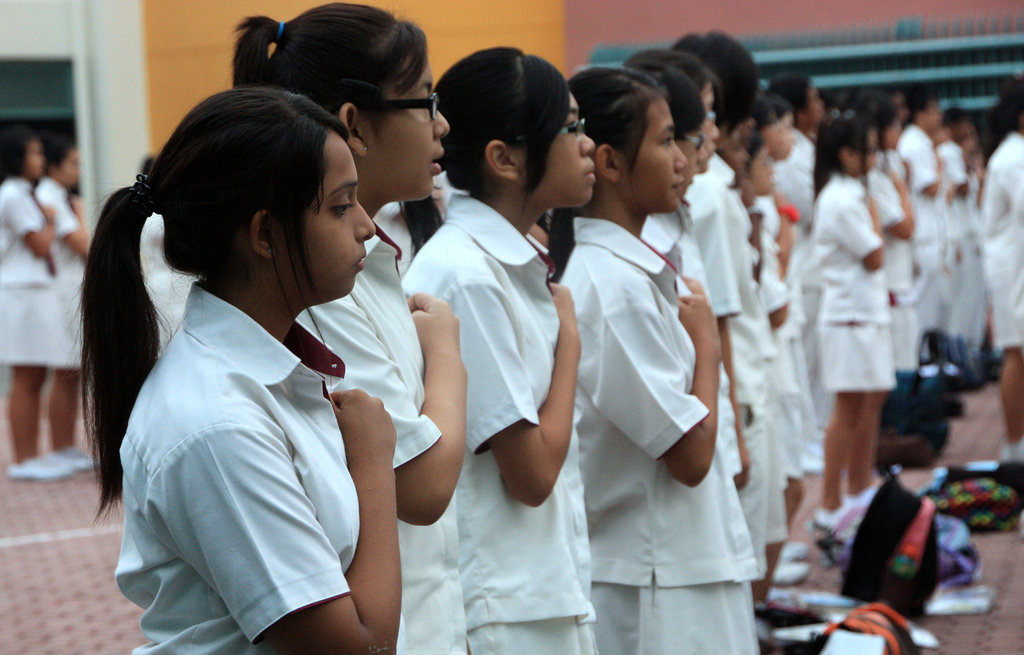
School in Singapore. (Photo: Rosipaw)
In light of all this hype, I spent the past week in Singapore visiting schools to find out why they are so successful. But, not surprisingly, there’s no big secret or magic trick that the United States could simply copy tomorrow. Rather, my impressions were of a nation where education is respected, where educators and administrators think critically about their jobs and the qualities they want their students to develop and where self-reflection is ingrained. Those are qualities already found in many American schools, and that reformers are trying to spur in others.
But some of Singapore’s latest strategies go beyond or challenge some of the most popular ideas right now for improving American schools. At the same time, it’s important to remember the vast differences between the two countries that make it difficult to transfer ideas. Here are my main takeaways from my conversations with educators, students and education officials:
– Singapore is looking to revamp their standards. As most states in America continue the rollout of the Common Core State Standards, an internationally benchmarked guide laying out what students are supposed to learn in each grade in math and English, Singapore also has changes planned. But education officials there are more concerned about some less tangible skills, like collaboration and creativity, and coming up with ways to systematically introduce those into the curriculum. In theory, the end goals of Common Core and Singapore’s newest push are similar. They both aim to create individuals with critical thinking skills who can thrive in a modern economy. But as we try to copy Singapore’s methods, like their math sequencing, educators there are already moving on to new ideas.
– Lots of Singaporean students are stressed. The country is looking for ways to reduce this and trying to decrease the emphasis on grades and test scores. The Ministry of Education is trying to reduce the emphasis on the primary school exit exam, which all students have to take to determine which secondary school they will attend, for instance. But many people told me one of the biggest challenges will be changing the mindset of parents. Not all students in Singapore worry endlessly about exams, but several people said that for those that do, parents are a primary source of their anxiety.
– Singapore is small. As several people pointed out to me, if you drive for an hour in any direction, you arrive at the water. While some people told me the small size of the country has disadvantages for education – it severely limits options for field trips for instance – it also has its benefits. Most notably, the country’s size, along with the fact that the schools are run by a centralized authority, allows the Ministry of Education, the National Institute of Education – which trains every teacher in the country – and the schools to be in close communication about research and new strategies. New programs can be implemented quicker and the National Institute for Education can easily keep track of what is actually happening in classrooms to tweak its offerings when needed.
– The schools are big. Half a million students are enrolled in the island’s schools, but most schools have student populations of more than a thousand – even at the primary level. With that many students, classes of 35 to 40 are typical, but nothing seemed disorderly. The atmosphere in the classrooms that I visited switched between formal and relaxed. Students bowed to greet visitors and again to thank them for coming. They stood up to speak whenever called upon, and chatter while a teacher was talking was almost nonexistent. At the same time, though, laughter was common. Teachers would gently tease students and discussion was highly encouraged.
Not everything Singapore does would apply to our much larger, decentralized education system and not everything they do should be emulated. But there are some inspirations we could draw from the country, such as trying to get more high-performing students into the classroom as teachers or being more explicit in the character qualities we want students to develop – without obsessing over how to measure them.
Mississippi sees improvement in AP scores, but still last in the nation
More low-income and black students in Mississippi are passing college-level Advanced Placement exams in high school although pass rates for students overall remain low and stagnant, according to a report released Wednesday.
Click to read the series
The College Board’s 10th annual Report to the Nation examines trends in participation and performance on Advanced Placement (AP) exams across the country. Since 2003, the percentage of all graduating low-income students in Mississippi who received a passing score of a three, four, or five has grown from about 8 percent to more than 20 percent. (The report’s numbers encompass students who didn’t take the test.) At the same time, the percentage of the state’s graduating black students who passed an AP exam has grown slightly, from about 11 percent in 2003 to nearly 14 percent in 2013.
Despite the growth in black and low-income pass rates, Mississippi ranked last in the overall percentage of graduating students who received a passing score in 2013. Fewer than 5 percent of Mississippi’s graduating class passed an exam, compared to the national average of 20 percent, and more than 29 percent in Maryland, the state with the highest pass rate. Mississippi’s percentage of students graduating with passing score on an AP test has grown by only 1.6 percentage points in the last decade, the least amount of growth in the country.
Mississippi also has significantly fewer 11th and 12th grade students — and fewer who are enrolled in AP — than some of the highest performing states. In 2013, more than 121,000 students were enrolled in 11th or 12th grade in Maryland’s public schools, and about 50 percent of graduating students took an AP course. By contrast, that same year, Mississippi had only about 60,000 students enrolled in 11th or 12th grade, and about 13 percent of graduating students took an AP course.
The data comes at a time of increased attention to college and career readiness in the state, especially in the areas of science, technology, engineering and math (STEM). Within the next five years, an estimated 46,000 STEM-related jobs will become available in Mississippi, and most will require a two- or four-year college degree. The Advanced Placement program offers 12 college-level classes in science, math, and computer science. If high school students pass the course exam, they can often earn college credit.
In Mississippi, a dwindling number of high schools are offering AP courses. Only 150 schools participated in the AP program in 2013, compared to 189 schools in 2008. Statewide, few students are taking AP courses in a STEM field. In 2013, only about 2 percent of graduating students took an AP math or computer science exam, and about 3 percent took a science exam.
Black students in Mississippi are especially underrepresented in these courses. More than 220 white students took the AP Chemistry exam in 2013, and 53 students, or about 24 percent, passed. In contrast, only 89 black students took the exam, and only four students passed.
