Our recent post on the long school days that some Chinese students put in got me wondering what kind of connection there might be between lots of classroom time and student performance on an international level. After all, Chinese students scored remarkably high on the latest PISA test.
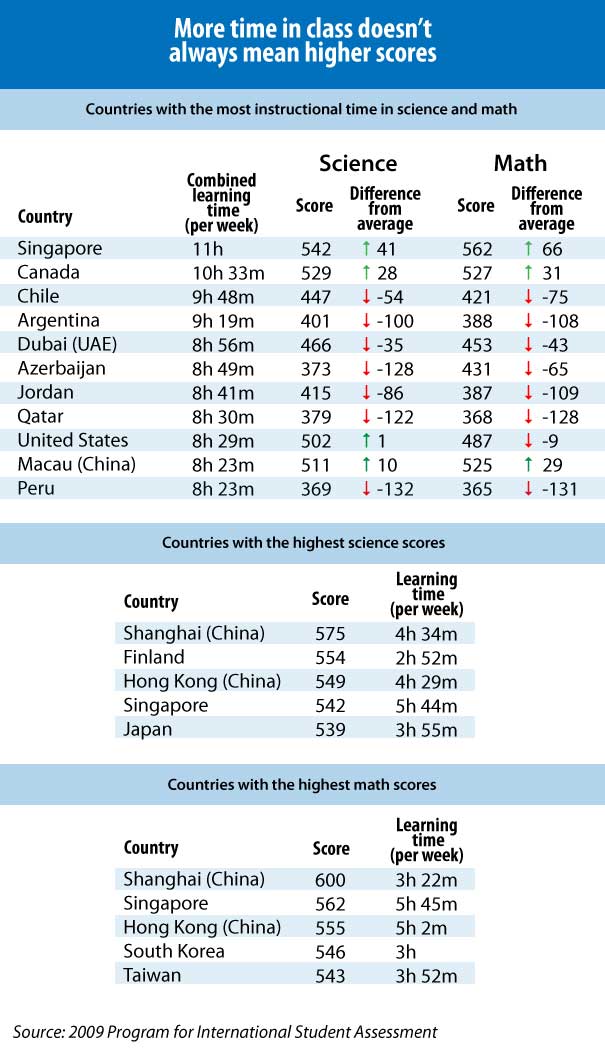
Turns out there really isn’t an ironclad connection, as the graphic below shows. Certainly students in some countries with lots of instructional time perform well, but students in other top-ranking nations, like Finland, are able to post high scores with much less classroom time. And students in countries like the U.S. can put in lots of class time and still get average scores.


Comments & Trackbacks (4) | Post a Comment
at 12:48 pm
[...] Post No “ironclad” link between more time in a classroom and learning – HechingerEd Blog Tweet You must register or login to post a [...]
at 6:44 pm
[...] PISA scores from around the world suggest lots of studying time doesn’t always pay off. (Hechinger) [...]
at 1:47 pm
[...] from the Hechinger Report reveals a mixed performance when time in seat is compared with educational accomplishment. Of [...]
at 8:04 pm
Um, you can’t just put seat time in one column, PISA scores in the other, and then draw a conclusion. There are dozens — at the very least — of potential confounding variables.
Maybe Chile, for instance, would be doing even worse — because it has a terrible curriculum — and the only thing saving it from placing dead last is seat time. (That’s just a hypothetical, obviously, and for the record I know nothing about Chilean education.)
This difficulty is why academic research is valuable. It’s not just using fancy words, it’s painstakingly isolating the variables that you care about. I’m sure there is empirical work on this subject out there.